
"Rags to Riches" - that's not just the name of a book, that's what this country was all about. We invented the "free enterprise" system, where anybody, no matter who he was, where he came from, what class he belonged to - if he came up with a better idea about anything, there's no limit to how far he could go.
I grew up a generation too late, I guess, because now the way the system works the loner, the dreamer, the crackpot who comes up with some crazy idea that everybody laughs at, that later turns out to revolutionize the world - he's squashed from above before he even gets his head out of the water because the bureaucrats, they'd rather kill a new idea than let it rock the boat!! If Benjamin Franklin were alive today, he'd be thrown in jail for sailing a kite without a license!...if big business closes the door on the little guy with a new idea, we're not only closing the door on progress, but we're sabotaging everything that we fought for! Everything that the country stands for!!
And one day we're going to find ourselves at the bottom of the heap instead of king of the hill, having no idea of how we got there, buying our radios and our cars from our former enemies.
Preston Tucker - Closing Argument
Showing posts with label Inspiration. Show all posts
Inspiration to innovation
How Does Culture & Cake Relate?

Great leaders all agree on three main focuses toward followers or employees: Vision, Inspiration & Engagement. I'm going to use an analogy of baking a cake (Our culture), and these focuses are each layer of the cake. Because, culture isn't just defined (noun) as the behaviors that make up the social environment of an organization, but culture is also defined (verb) to cultivate, nurture or grow. We can't ignore the culture of our work-group, department, company or industry for a second, because it is how we are able to find top-talent in a dense market, retain the top-talent within our organization, and remain innovative against competition.
While working in one of my previous roles, I experienced a culture that encouraged innovation, independence, ambition, persistence and life-long personal development. The departments there were very large, and had lots of opportunities for growth. Whereas working in a different department, but within the same company, there were signs of deep bureaucracy, which inhibit growth and development opportunities, including chances to showcase your innovation. Since departments are grossly smaller; little examples of ambition could be quickly taken as over-ambition or aggressiveness, confidence is thought of as arrogance, and if you're independent (or a self-starter) then you're not a team-player. These statements are not just from personal experience, but from connecting with other employees who have shown loyalty to the company for more than 5 or even 10 years, and, the kicker, they aren't even all from the same departments. This shows the organizational culture differences down to the micro-organizations, the departments and work-groups.
So, how about we get back to our cake.
Vision.
Being the foundation of leadership, the leader's vision should be effectively communicated to the team. How you execute (flavor) that vision is completely up to you, but keep in mind that every team member is different, and individual feedback is the best flavor (for me, it's strawberry) in most cases.
I experienced a great example of this when I watched an episode of Restaurant Stakeout, hosted by Willie Degel (Owner of Uncle Jack's Steakhouse in New York City). After visually confirming various business, and leadership, flaws by watching hidden cameras, Willie addresses the entire team about the areas of needed improvement. Afterward, he meets with each individual and provides constructive criticism and development opportunities, and advancement opportunities for the strong individuals.
In the particular episode I was watching, Willie apologized to one of the employees during their individual meeting. He said, "I wanted to first apologize for coming off a little strong and maybe harsh in the team meeting. I'm sure you can see my passion for the subject-matter at hand. I really wanted show how serious of an issue this is." (A little background: The business was losing significant money because of a low-priced all-you-can-eat special where customers were taking food home and sharing, and the employees were not reinforcing the rules of the business.)
This example really shows how all three layers of the cake are needed to establish our culture, but first focus on how Willie executed the new vision. This style will help establish the culture of team accountability, because everyone on the team was in the first meeting. So, everyone on the team knows exactly where they should be, and where they shouldn't be.
Inspiration.
My past experiences have given me a great perspective on what inspiration looks like, and how it is expressed. Think of inspiration as the filling to your cake. Sugar and cream are your base ingredients, just like passion and tenacity are the base to inspiring others.
John F. Kennedy made his speech about the space program, and our efforts to put a man on the moon in 1962. His passion and enthusiasm for the subject-matter encourages those involved to accomplish the mission first and within the decade. Another incredibly inspirational speech is Martin Luther King Jr's, "I have a dream." This same passion, drive and enthusiasm is exemplified in another TV show I watched recently, Treehouse Master's. Where they follow master tree house builder, Pete Nelson, as he and his crew designs and constructs some very incredible tree houses. You can just feel his passion through the TV screen. "To the trees!"
Engagement.
How you engage your team members will provide the framework to how you want your team members to engage you. Your engagement is what will truly compliment your vision (Like this chocolate layer of cake compliments the strawberry base). Employees who are engaged in the workplace are more likely to 'own' their work and align to the vision of the organization, according to research by the Gallup Organization. Glassdoor.com recently posted an article, by Trish McFarlane, about what Millenials look for in a company's environment, and one of them was: How are employees recognized? Although bonuses and other perks are great, Millenials just want to get recognized for doing good work. An article in Forbes, by Ty Kiisel, cites research by MTV titled, "No Collar Workers". The analysis points that because of the immediacy of social media, “…80% of millennials said they want regular feedback from their managers, and 75% yearn for mentors.” With numbers like that, effective engagement is critical.
An article posted last year, by Todd Nielson, "Are You Making Your Employees Stupid?" points out a statistic by Merrill Lynch that "50% of employee skills become outdated in 3-5 years." So, why aren't you developing, and diversifying your team?
In the show, Restaurant Stakeout, Willie returns to the business just a few short months later. Allowing enough time for the restaurant to implement the suggested changes, and ensure that everything is still aligned with the initial vision. Willie also verifies whether the weak team members took his development advice.
The attached video is not the episode I watched, but it's a fantastic example of the three focuses. I cut out the middle portion of this episode.
Now, let's ice our cake.
It really is as sweet as it sounds. This chocolate frosting will add the perfect final touch to our chocolate covered strawberry cake. By identifying, recognizing and rewarding the performers who are working toward the vision, and heeding any developmental advice, you are able to better influence this new constructive culture. This outer layer is so important. It protects your cake (vision, inspiration & engagement) from getting dried out and stale. Sometimes there's a shell that falls into the mix when we crack the egg, and the solution still stands: Get rid of it as soon as possible. You don't want to mix that into your cake. It will spoil all your hard work.
An organizational, or micro-organizational, culture takes nurturing. Constantly tending to the three focuses; your vision for the project or mission, inspiring your team, and engaging team members with frequent feedback to ensure the success of achieving your vision. After all, isn't that why we call it culture? Because of its convenient double meaning? The norms and practices of our environment, and the constant work it takes to maintain that desired environment.
I hope this post was helpful in identifying three focuses to correct and align to a productive culture. Please share and follow me @AlexGaskins on Twitter. Hopefully you didn't get too bad of a desert craving.
Integrity : Most important in leadership.
Out of all my research and experience, I have found that integrity is the most important virtue for a leader. It's what makes a good leader, a great leader, humble leader, reliable leader, and respectable leader. Many articles and books write about leadership virtues being; respect, honesty, humility, courage, patience and/or openness. They touch on integrity, but I haven't found many that highlight and focus solely on integrity. Especially from a perspective of a leader who is not in a role, or "title", of leadership.
As a leader, you must have good moral judgment. A question you can ask yourself is; Am I frequently being trusted to handle special tasks or projects? The answer to that question will show you the level of respect and credibility you've gained. These are intrinsic rewards to integrity. More than this question; Are you fulfilling your current job duties? Are you asking questions when you need help, so that you can complete tasks? Are you enabling yourself to go above and beyond the call of duty? Good moral judgment is much more than just knowing the right and wrong of ethics. It is the ownership and unity of ethics in your own personal judgment.
"Moral excellence comes about as a result if habit. We become just by doing just acts, temperate by doing temperate acts, brave by doing brand acts"
Aristotle
Honesty is what will prove whether your moral judgment is good or bad. It defines your trustworthiness. In this case, your actions will speak volumes. Do you have the company's best interest in mind? Are you mindful of your team? Or, are you only trying to benefit yourself? Don't give your leadership any reason to think you're being dishonest. I've seen it over and over, when someone seems like they have a vendetta, they also come off as being dishonest. Be mindful of your actions. Practice what you preach. Associate yourself with good company.
"Associate with men of good quality if you esteem your own reputation; for it is better to be alone than in bad company"
George Washington
Consistency should not be confused with continuity or fairness. Where consistency relates to your actions/attitude over time, and continuity or fairness relates to your actions/attitude between each task or individual. Good leaders remain consistent, but great leaders consistently grow and perform better. It's always good to ask yourself if you're improving, or focusing on improving, from yesterday. Are you consistently reliable? Diligent? Trustworthy?
"Leadership can't be fabricated. If it is fabricated or rehearsed, you can't fool the guys in the locker room. So, when you talk about leadership, it comes with performance. Leadership comes with consistency."
Junior Seau
Continuity or fairness is how you relate between each task or individual. This is how you gain respect and credibility. This particular character trait really only comes out when we're thrown a curve ball. How do you handle a new policy, procedure, or process? How do you deal with barriers or hardships? Let's look at a bridge for example: It's purposes is to carry vehicles over something (road, revine, gorge, canyon, etc). The continuity of handling wear-and-tear, to handling an earthquake, should be the same to maintain its integrity. There must be structure and accountability to maintain continuity in leadership. For the bridge, its structure is providing the same service routinely, and its accountability is the checks performed regularly for it to maintain its integrity.
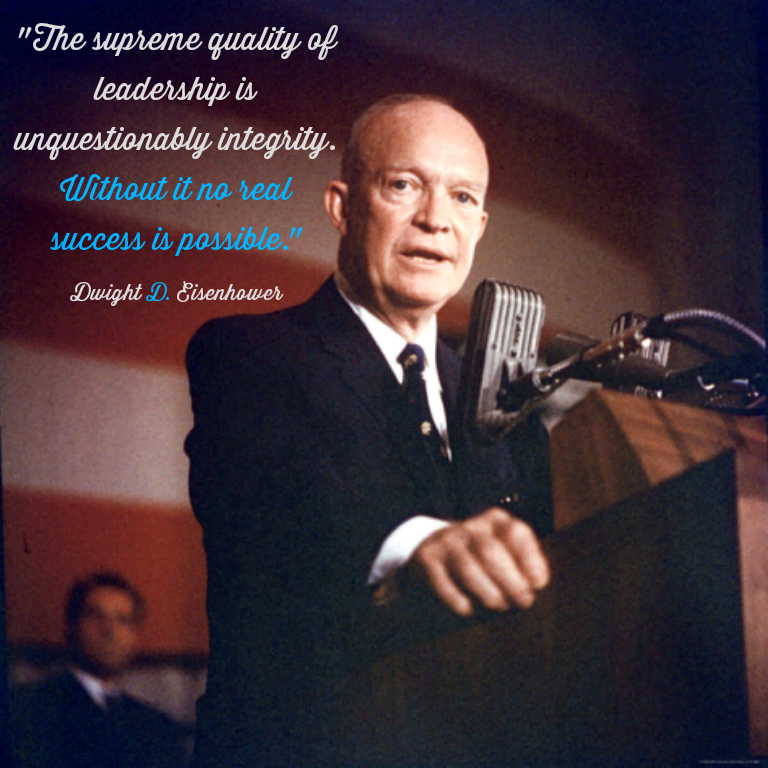
"The supreme quality of leadership is unquestionably integrity. Without it no real success is possible..."
Dwight D. Eisenhower
Respect is an earned reward achieved through exemplifying the above qualities. Without it, no real leadership happens. Followers must buy your vision, respect you, and consider you a credible source. Lee Cockerell writes in his book, Creating Magic, about the acronym RAVE; respect, appreciate and value everyone. This absolutely outlines where respect is given, respect is received. Always remember, performing RAVE doesn't entitle you to the respect of others. You must display the above attributes of integrity. Showing that you feel entitled will only cause you to lose respect and credibility.
"Men are respectable only as they respect"
Ralph Waldo Emerson
Did you enjoy this article? Share, comment, and follow for more like this.
Change Leadership
 In my experience, many organizations work under the mantra; Change is constant, yet purposeful. Although, the purpose can be something as simple as experimenting with a new idea, or extravagant as an implementation based on statistical strategic forecasting and planning. An innovative team must be
adaptable to the change to sows.
When discussing change and leadership, we need to look at change as an opportunity to show how strong and adaptable the team is. It is up to you, as the leader, to be the motivation and encouragement to your team. John C. Maxwell said, "Change is inevitable. Growth is optional." How you react to change is what will inspire others to either be an advocate of change, or an adversary. Good leaders grow, but great leaders grow with everyone together.
John Kotter writes several book on leading change. He breaks down change leadership into 8 steps: Create a sense of urgency, Create a powerful coalition, Create a vision for change, Communicate the vision, Topic Remove obstacles, Create short-term wins, Build on the change, and Create a change culture.
Creating urgency requires the team to have "buy-in" and own the vision of change. The entire team should be supporting one another in accountability toward the change. To build a sense of urgency, have genuine and convincing conversations about the topic with the influencers within the workgroup. This will also help build a needed coalition.
These advocates for change must work together. Constantly increasing momentum surrounding the topic of change. A great way to build momentum is to have your team gain ownership in the vision. Creating a clear vision for change is absolutely critical. Share the vision through core values, credible support (by your coalition), and providing an execution strategy.
How you share your vision is up to you. It can be in a morning meeting, a formal presentation, or in one-on-one conversation, but be sure to let you passion for the change shine through. This is how you will drive the change. Connect everything back to you're vision, and talk about it frequently.
As you've gained the necessary momentum, you'll be able to identify change barriers more easily. Quick and swift action will be needed to remove threats and obstacles preventing change. Lift up those who are the advocates for your change vision. Remove, and redirect, those who are not supporting your goals and vision. Reward those short-term targets that have been met.
Share the "wins" with the entire team, and organization (if needed), to motivate and maintain change momentum. By acknowledging the short-term goals, you will be ensuring the team's focus on the vision. Continue to instill the drive for change by building on the change.
In my experience, change comes to an abrupt stop when the team celebrates the achieved vision, but doesn't know where to go next. So, identify the strengths and weaknesses during the change process, and address them with the team. Allow them to grow. Have the team provide criticism for future change, and a new vision for the future. This will give them ownership in the change culture.
Don't forget to recognize and inspire key change leaders, and share their success stories to inspire others to partner in the change culture. Leaders within teams should be advocates of an adaptable workgroup.
The Importance of Innovation

Staying ahead of the pack requires a willingness to entertain ideas, take calculated risks, and allow the freedom to fail. Constant SWOT analysis (Strengths, Weaknesses, Opportunities, & Threats) helps to provide a deep understanding of why something failed, what was good/bad, and what could be better. These types of analysis allows the ability to answer the necessary, "What if?", questions that inspire strategic thinking.
Performing on a worldwide stage at the 1968 Olympic games in Mexico City Dick Fosbury revolutionized the sport of high jump when he performed an incredible risk, jumping head first. His technique became known as "The Fosbury Flop". This level of innovation took his jump to 2.24 meters, higher than any other attempt.
Streamlining communication helps harbor innovation in workgroups. Teams and departments need to have the opportunity to communicate frequently for innovation to thrive. The days of tall organizational structures are gone. In my personal opinion, it's because we live in a fast world where our attention span averages less than 10 second. Because of our demand for frequent change and the new, we've had to flatten structures, streamline processes, and increase the importance of time and efficiency. Flatter structures allow for teams, partners, and departments to collaborate seamlessly.
This video of the Gwinnett Gladiators Head Coach, Jeff Pyle, explaining a line-change is a great example. Note how he puts and emphasis on streamlining communication. He also recognizes the scope of his players' abilities, and then places a time boundary to ensure the tempo of the game is not delayed. At 01:22 Coach Pyle emphasizes, again, on the importance of communication, and how the lack of effective communication could result in a penalty.
Leaders of workgroups should strive to create a strong collaborative momentum. Taking a lesson from something like a line-change in hockey, or a high jump technique, proves that innovation is everywhere. It is up to us as leaders within our workgroups to take advantage of the benefits offered through innovating.
Being innovative is not just about bringing new ideas to processes, procedures and/or products. Being innovative is also about utilizing the people within your team the their full potential. By putting certain people in the right place, you're taking advantage of a potential opportunity to develop team members. Great leaders stand out when they are leading other leaders.
“The greatest leader is not necessarily the one who does the greatest things. He is the one that gets the people to do the greatest things.” -- Ronald Reagan
“Leadership is not about titles, positions or flowcharts. It is about one life influencing another.” -- John C. Maxwell
Stonewalling : The unspoken sin.
 For the first blog post, I wanted to write about something extremely common in the workplace, but never talked about. Various educators, and researchers, around the world have said stonewalling should be considered as a toxin in the workplace. I call it the unspoken sin. It's that thing that holds back progress, but no one seems to know what the barrier is.
You might be able to pinpoint stonewalling when you experience meetings that never solve anything, constant changing of topics, project partners "dropping the ball", or false rumors around the office. A stonewaller is usually someone who is only out to protect their own image and interests. They could be silent, or they could be extreme. A person usually becomes a stonewaller when they feel threatened. Or, maybe they don't want to lose a valuable member of their team.
There are 3 things to keep in mind, if you feel like you're being stonewalled:
1. Remain positive. Giving off that positive vibe will encourage people to follow and support your actions. It will also show your leadership that you are resilient, and can remain focused on completing your job duties or projects.
2. Be assertively ambitious. This requires you to take initiative, but be careful not to be aggressive in your actions. Make sure you ask before handling a task you weren't directly assigned. You don't want to put affirmation to the words of your stonewaller.
3. Have integrity. Don't feed the drive of your stonewaller by falling into the workplace gossip trap. In fact, don't even fall into the gossip trap outside of work (that includes on social media). A co-worker of mine once said, "Think of every day as an audition for your future job." It's true. You want everything you do, to give you the image your future job is looking for. I may touch on this topic in the future, but this is called your personal brand.
Here are a few links to some good reads:
Signs you're a horrible boss - Forbes
Being positive improves your career - Forbes
Secrets of leadership success - About.com