Showing posts with label Servant Leadership. Show all posts

Initiative : The first step.

No Comments »

Taking initiative - The first stepThe word initiative comes from the base root of initiate. It's etymology; latin prefix in- means to innovate, review, bring a new idea or method, or begin, and suffix -ive means to make or to cause. By breaking down the word 'initiative'. It will help draw a clearer picture, and outline how important it is for leaders to exemplify this characteristic. Before taking initiative you must recognize, and overcome three barriers: Knowledge, Fear, and Stress.

Knowledge. Probably the most common barrier preventing initiative, is knowledge. This requires the confidence and humility to ask questions. When you feel like you lack knowledge, think...learn and leverage. This is a great opportunity to look at your team to use their strengths in areas where you may have a weakness. Can you learn the necessary task quickly? Can you leverage other individuals to use their skills for you? For example: You're leadership team has tasked you with creating a Keynote presentation, but you don't know how to use Keynote software. Good news! Someone on your team is familiar with the software. You can take advantage of this opportunity by asking for a quick training from them, or leverage their ability to help you complete the task. (Don't forget to provide them with due credit for helping.)

Fear. If you are consistently experiencing lackluster, it may attribute to fear. A very common emotion associated with initiative. Fear of failure, embarrassment, and/or rejection. By embracing your emotion of fear, asking for help, and opening up to utilize the gifts of others within the team, you're able to turn this weakness into a valuable strength. To overcome fear, you must become vulnerable. Brené Brown explains the power of vulnerability in her TED Talks video and book titled, Daring Greatly.


"Vulnerability is the birthplace of innovation, creativity, and change."
- BrenĂ© Brown -

Stress. When affecting initiative, we associate stress with overwork, overwhelm, pressure, and too much responsibility. If you're feeling overwhelmed, it's time for some reevaluation of current projects and delegation on new initiatives. Take a step back and review what energize and which exhaust you. Then pass along the tasks which exhaust you onto team members who's strength will be best utilized. A great example of this team work is the ant. When they come across food that is to large for them to carry, they recruit other foragers from their colony to assist them. They proceed to dismantle and carry the food together, in manageable sizes.

"Talent wins games,
but teamwork and intelligence wins championships."
- Michael Jordan -

Integrity : Most important in leadership.

No Comments »

Out of all my research and experience, I have found that integrity is the most important virtue for a leader. It's what makes a good leader, a great leader, humble leader, reliable leader, and respectable leader. Many articles and books write about leadership virtues being; respect, honesty, humility, courage, patience and/or openness. They touch on integrity, but I haven't found many that highlight and focus solely on integrity. Especially from a perspective of a leader who is not in a role, or "title",  of leadership.

Good moral judgment, honesty, consistency, continuity/fairness, respect...are just a few attributes typically associated with someone of good integrity. Webster's dictionary defines integrity as someone who is firm to a code of especially moral conduct or artistic values. This article will go over these traits individually, and outline how they are manifested in an individual's leadership style.

As a leader, you must have good moral judgment. A question you can ask yourself is; Am I frequently being trusted to handle special tasks or projects? The answer to that question will show you the level of respect and credibility you've gained. These are intrinsic rewards to integrity. More than this question; Are you fulfilling your current job duties? Are you asking questions when you need help, so that you can complete tasks? Are you enabling yourself to go above and beyond the call of duty? Good moral judgment is much more than just knowing the right and wrong of ethics. It is the ownership and unity of ethics in your own personal judgment.

"Moral excellence comes about as a result if habit. We become just by doing just acts, temperate by doing temperate acts, brave by doing brand acts"
Aristotle

Honesty is what will prove whether your moral judgment is good or bad. It defines your trustworthiness. In this case, your actions will speak volumes. Do you have the company's best interest in mind? Are you mindful of your team? Or, are you only trying to benefit yourself? Don't give your leadership any reason to think you're being dishonest. I've seen it over and over, when someone seems like they have a vendetta, they also come off as being dishonest. Be mindful of your actions. Practice what you preach. Associate yourself with good company.

"Associate with men of good quality if you esteem your own reputation; for it is better to be alone than in bad company"
George Washington

Consistency should not be confused with continuity or fairness. Where consistency relates to your actions/attitude over time, and continuity or fairness relates to your actions/attitude between each task or individual. Good leaders remain consistent, but great leaders consistently grow and perform better. It's always good to ask yourself if you're improving, or focusing on improving, from yesterday. Are you consistently reliable? Diligent? Trustworthy?

"Leadership can't be fabricated. If it is fabricated or rehearsed, you can't fool the guys in the locker room. So, when you talk about leadership, it comes with performance. Leadership comes with consistency."
Junior Seau

Continuity or fairness is how you relate between each task or individual. This is how you gain respect and credibility. This particular character trait really only comes out when we're thrown a curve ball. How do you handle a new policy, procedure, or process? How do you deal with barriers or hardships?  Let's look at a bridge for example: It's purposes is to carry vehicles over something (road, revine, gorge, canyon, etc). The continuity of handling wear-and-tear, to handling an earthquake, should be the same to maintain its integrity. There must be structure and accountability to maintain continuity in leadership. For the bridge, its structure is providing the same service routinely, and its accountability is the checks performed regularly for it to maintain its integrity.

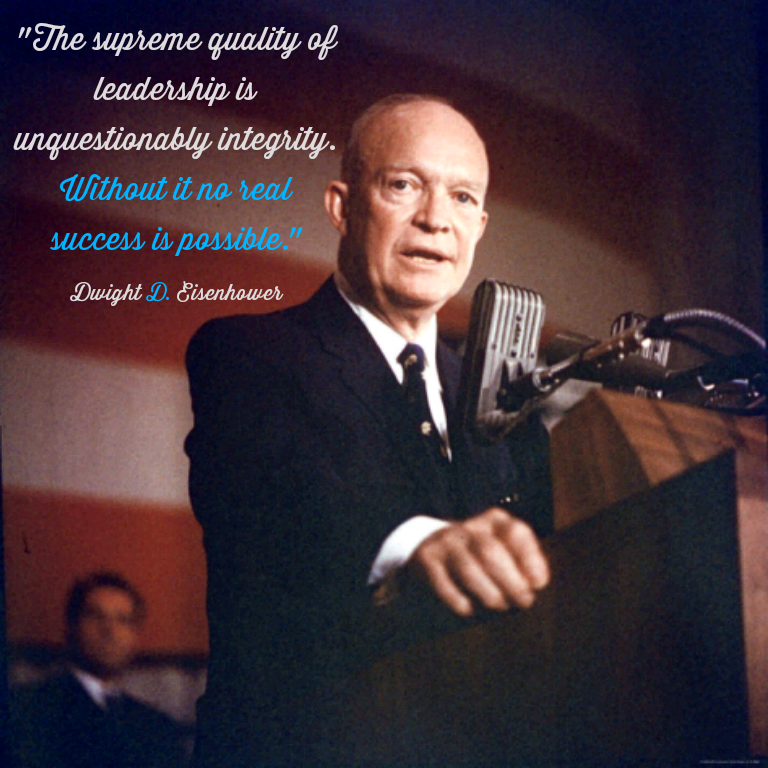
"The supreme quality of leadership is unquestionably integrity. Without it no real success is possible..."
Dwight D. Eisenhower

Respect is an earned reward achieved through exemplifying the above qualities. Without it, no real leadership happens. Followers must buy your vision, respect you, and consider you a credible source. Lee Cockerell writes in his book, Creating Magic, about the acronym RAVE; respect, appreciate and value everyone. This absolutely outlines where respect is given, respect is received. Always remember, performing RAVE doesn't entitle you to the respect of others. You must display the above attributes of integrity. Showing that you feel entitled will only cause you to lose respect and credibility.

"Men are respectable only as they respect"
Ralph Waldo Emerson

Did you enjoy this article? Share, comment, and follow for more like this.

Development and Diversity : Underrated?

No Comments »

There are many articles that write about underrated qualities in a great leader. Nearly all of them describe the same qualities; accountability, innovative, subject acumen, or flexibility. I never seem to hear people talk about two characteristics that I'm always looking for in my leaders. Development and diversity are, in my professional and personal opinion, the most underrated character traits in great leaders.


Development

Keep in mind that I am looking at development from a coaching perspective. Great leaders are lifelong learners, and always find ways to inspire their followers to have the same passion for learning. Leaders with this attribute are difficult to find, because their entire clan is keeping up with their pace. They're able to pinpoint weaknesses in their followers, provide them with development resources, and motivate and inspire them to follow through on the opportunities to grow.

Tony Robbins has a great quote on growth, "If you do what you've always done, you'll get what you've always gotten."

The truth of this is that great leaders find ways to encourage, grow and develop their team members, because they realize they will only get the same results if they don't progress, change and adapt. While good leaders are trailing behind, motivating their team to develop on their own. Great leaders are tracking the progress of their team's development, and forecasting to prevent the next hiccup.

Diversity

Something that I've always cherished in an individual on my team, diversity as a characteristic is someone who holds a wide range of experience to provide a, jack of all trades if you will, range of skills, knowledge and abilities. This quality is something that I feel is only view under race, gender and creed. Great leaders are not only teachable but great teachers too, not only good talkers but great listeners, not just good at time management but they're great under pressure when things don't go as planned. They have both blue collar and white collar skills, not afraid to get a little dirty if needed, but are also on top of their administrative duties.

In my experience, I've only ever met one person who was truly diverse. He showed empathy, but knew exactly when to draw the line. My dad would try his best to learn and master a new skill, but he knew when it was time to delegate. His level of ambition, and integrity, for a project was contagious. It developed a sense of pride, and ownership, for a project within everyone involved.

This type of diversity is the very thing bottom line employees seem to complain about in their managers. The most common complaint: "My boss doesn't even know what I do." Being diverse means; you understand the basic duties of the people involved on your team. This allows you to recognize their hard work, while helping to brainstorm through inefficiencies.

I can only hope that by now you understand the importance of being diverse and driving development. These two attributes really do make good leaders great.

Let me know your thoughts or experiences.